The next generation of refuse truck fire protection
The fire doesn’t wait.Neither should your fleet.
FireGuard GT is developing an integrated fire detection and mitigation platform for garbage trucks—engineered to identify dangerous conditions sooner, respond intelligently, and help protect drivers, equipment, and communities.
Concept-stage technology. Performance and certification testing are planned.
- Development stage
- Concept
- Performance testing
- Planned
- Certification
- None claimed
The problem
A small battery. A very big problem.
A discarded battery or other ignition source can enter a refuse truck unnoticed. Once waste is compacted, a fire may develop out of sight and become difficult to reach. By the time smoke is visible, the operator may already be facing a dangerous and costly incident.
Hidden ignition
Damaged batteries, hot ashes and other materials can initiate a fire within mixed waste.
Limited access
Tightly packed refuse may block water, foam, or other agents from reaching the ignition source.
Operational consequences
A fire can threaten the crew, truck, nearby property and service continuity.
The approach
Built around the reality of a garbage truck.
FireGuard GT brings together monitoring, targeted suppression concepts, driver alerts, and a disciplined emergency-response workflow. Rather than treating the hopper like an ordinary engine compartment, the platform is being designed around moving waste, harsh environments, and hard-to-access ignition points.
Detect
Monitor temperature and abnormal thermal trends in critical zones.
Respond
Activate engineered suppression functions when appropriate.
Alert
Give operators clear warnings and actionable instructions.
Escalate
Support a controlled emergency response when a fire cannot be safely contained.
The technology
Multiple layers of protection. One integrated platform.
FireGuard GT is a modular development platform, designed to adapt to different refuse-body configurations and fleet operating requirements.
- Response workflowDriver-directed procedures for stopping, isolating, contacting emergency services and evaluating unloading only when authorized and safe.
How it works
From first warning to documented response.
Step 1: Monitor
Sensors watch designated truck zones for unusual thermal conditions.
Step 2: Assess
Control logic evaluates readings, faults and operating state.
Step 3: Alert
The operator receives a clear warning and recommended next steps.
Step 4: Mitigate
Validated suppression equipment may activate automatically or manually, according to the approved design.
Step 5: Escalate
If conditions persist, the operator follows emergency procedures and contacts responders.
Step 6: Document
System events can support maintenance review and fleet safety analysis.
Response logic and suppression effectiveness will be established through engineering tests and applicable approvals. The system is not a substitute for operator training or emergency services.
Fleet solutions
Built for the trucks your community depends on.
A refuse truck is more than a vehicle. It is a daily operating asset, a crew workplace, and an essential public service. FireGuard GT aims to make fire-risk mitigation more accessible through a modular architecture and a fleet-oriented maintenance model.
- Private haulers
- Municipal fleets
- Regional operators
- Fleet service providers
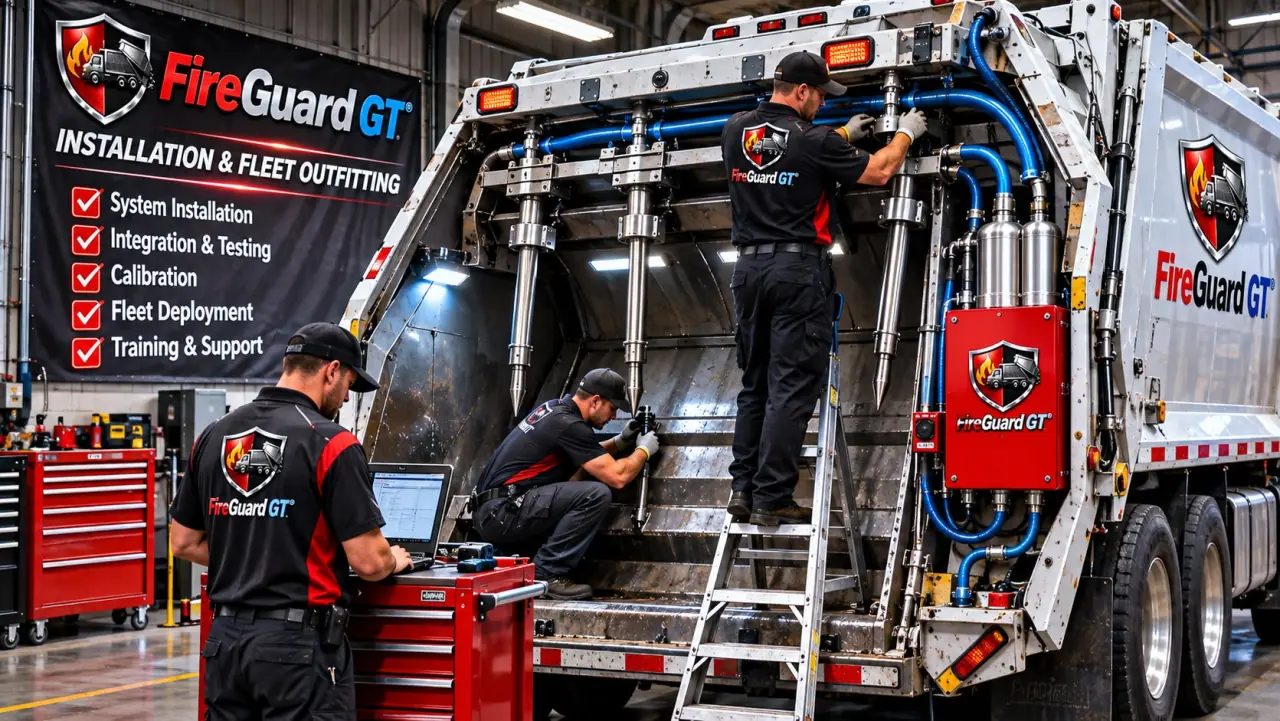 Concept illustration
Your next truck fire should not be your first plan.
Help shape a practical, affordable safety platform for refuse fleets. We are seeking fleet operators, municipal partners, OEMs, and fire-protection specialists for development discussions and pilot planning.
Development status
Where the project stands.
Concept-stage technology. Testing and certification are planned, not complete.
- Current
Concept and architecture
A modular platform concept: detection, localized liquid application, an optional separately engineered compartment module, operator alerts and response guidance.
Not scheduled. No dates are published until they are verified.
- Current
Pilot and partner discussions
Open to fleet operators, municipal partners, OEMs and fire-protection specialists for development discussions and pilot planning.
Not scheduled. No dates are published until they are verified.
- Planned
Engineering validation
Component selection, fitment studies and a safety case for each configuration. Subject to engineering review.
Not scheduled. No dates are published until they are verified.
- Planned
Controlled load-fire testing
Repeatable tests of detection and mitigation approaches. Whether agents can reach a fire inside compacted refuse is not yet established and is part of what testing must show.
Not scheduled. No dates are published until they are verified.
- Planned
Third-party evaluation and approvals
Applicable evaluation and approval of equipment and complete installations. No certification is claimed before this is complete.
Not scheduled. No dates are published until they are verified.
Straight answers.
Can FireGuard GT extinguish a fire deep inside compacted trash?
That is a central engineering challenge. Dense waste can prevent agents from reaching an ignition source. FireGuard GT is evaluating detection and mitigation strategies, but deep-core extinguishment must be demonstrated through controlled testing.
Is FireGuard GT available for purchase?
The platform is currently in development. Interested fleets and partners can contact the team to discuss pilot participation and future availability.
Will it fit my garbage truck?
The architecture is intended to support multiple refuse-truck configurations. Actual fitment will depend on vehicle make, body design, available space, power and safety requirements.
Does the system automatically dump burning trash?
No automatic unloading capability is being offered as a validated standard feature. Any unloading procedure must be safe, controlled, compliant and coordinated with operator and emergency-response protocols.
Will it protect against lithium-ion battery thermal runaway?
Lithium-ion battery events can reignite and propagate. The system may help with detection and surrounding fire mitigation, but battery thermal-runaway control requires specific testing and must not be guaranteed.
Start a development discussion.
Tell us about your fleet or organization and what you want to explore. A real person on the FireGuard GT team reads every inquiry.